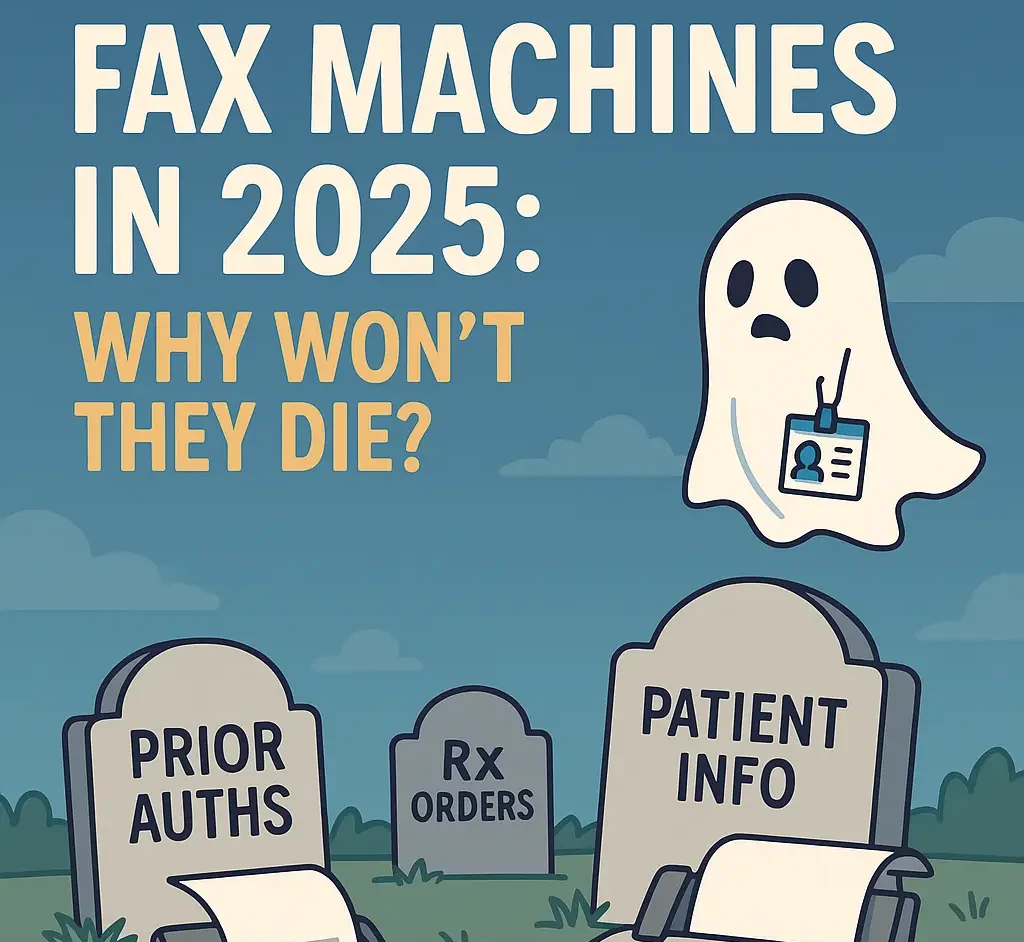
It’s 2025. We’ve got AI diagnosing diseases, telehealth bringing care to remote villages, and wearables tracking heart rhythms in real-time. So why are fax machines in healthcare still a thing?
The answer: a messy mix of legacy systems, legal mandates, and institutional inertia. Here are 10 jaw-dropping ways fax machines are still being used in today’s healthcare systems—some of which are costing providers millions and risking patient safety.
1. Prior Authorizations: Still Coming in on Fax
Despite electronic prior auth platforms, many insurers still rely on faxed forms to initiate or approve treatments, especially for specialty drugs and DME. Paper delays = patient delays.
2. Pharmacies Receiving Prescriptions from Clinics
Yes, e-prescribing exists. But when systems go down or when controlled substances are involved faxes are still the fallback. The irony? Most faxed prescriptions are then manually keyed into a system.
3. Nursing Homes Faxing Medication Lists
LTC facilities often lack robust EHR integration. So when a resident transfers to a hospital or pharmacy, staff fax over handwritten MARs, often with hard-to-read notes and errors.
4. Medical Records Requests via Fax
Hospitals still receive thousands of requests for records via fax every week, from law offices, insurance auditors, and yes, other hospitals. The reason? HIPAA compliant fax is “safe,” but slow. (U.S. Department of Health and Human Services, n.d.)
5. Discharge Summaries from Hospitals to PCPs
Even with shared EHR networks, it’s common for discharge notes to be faxed to primary care providers, especially when systems aren’t interoperable. Patients often beat their summary to the clinic.
6. Lab Orders and Results
Some clinics still fax lab orders to third-party labs, and in return, receive results…via fax. These are often scanned and manually uploaded to the EHR, a perfect recipe for misfiling.
7. Behavioral Health Clinics Sending Psych Notes
Mental health providers frequently operate in tech deserts. When coordinating care with other specialists, fax is still the “neutral” option everyone can handle.
8. Insurance Appeals and Medical Necessity Letters
Submitting documentation for appeals? Fax it. Even major commercial payers still require faxed letters of medical necessity, despite having portals that could handle uploads.
9. Patient Intake Forms
Believe it or not, some providers ask new patients to fax in forms ahead of their appointment, including health histories, IDs, and insurance cards. Because…email is “not secure enough.”
10. Communication Between Small Practices
Without shared EHRs, rural and independent providers rely on fax to communicate referrals, diagnoses, and treatment plans, some even using physical fax paper, not digital fax systems.
Why It Matters (and Why It Has to Change)
Faxing in 2025 isn’t just old-fashioned, it’s dangerous:
- Delays care
- Increases manual entry errors
- Wastes time and money
- Hampers interoperability and data tracking
- Compromises patient safety
Replacing faxes isn’t simple, but it’s necessary. Healthcare IT leaders must push for secure APIs, EHR interoperability, and modern, cloud-based workflows that prioritize speed, security, and accuracy.
Final Thoughts
Fax machines have outlived their welcome. They’re no longer a “safe bet”, they’re a barrier to better care.
So if you’re still using a fax in your workflow, ask yourself:
Is it legacy… or just laziness?
Enjoyed this post?
👉 Share it with someone in healthcare still using a fax machine.
🗨️ Comment below: What’s the most ridiculous thing you’ve seen faxed recently?
References
U.S. Department of Health and Human Services. (n.d.). Can a physician’s office fax patient medical information to another physician’s office? Retrieved May 30, 2025, from https://www.hhs.gov/hipaa/for-professionals/faq/356/can-a-physicians-office-fax-patient-medical-information-to-another-physicans-office/index.html