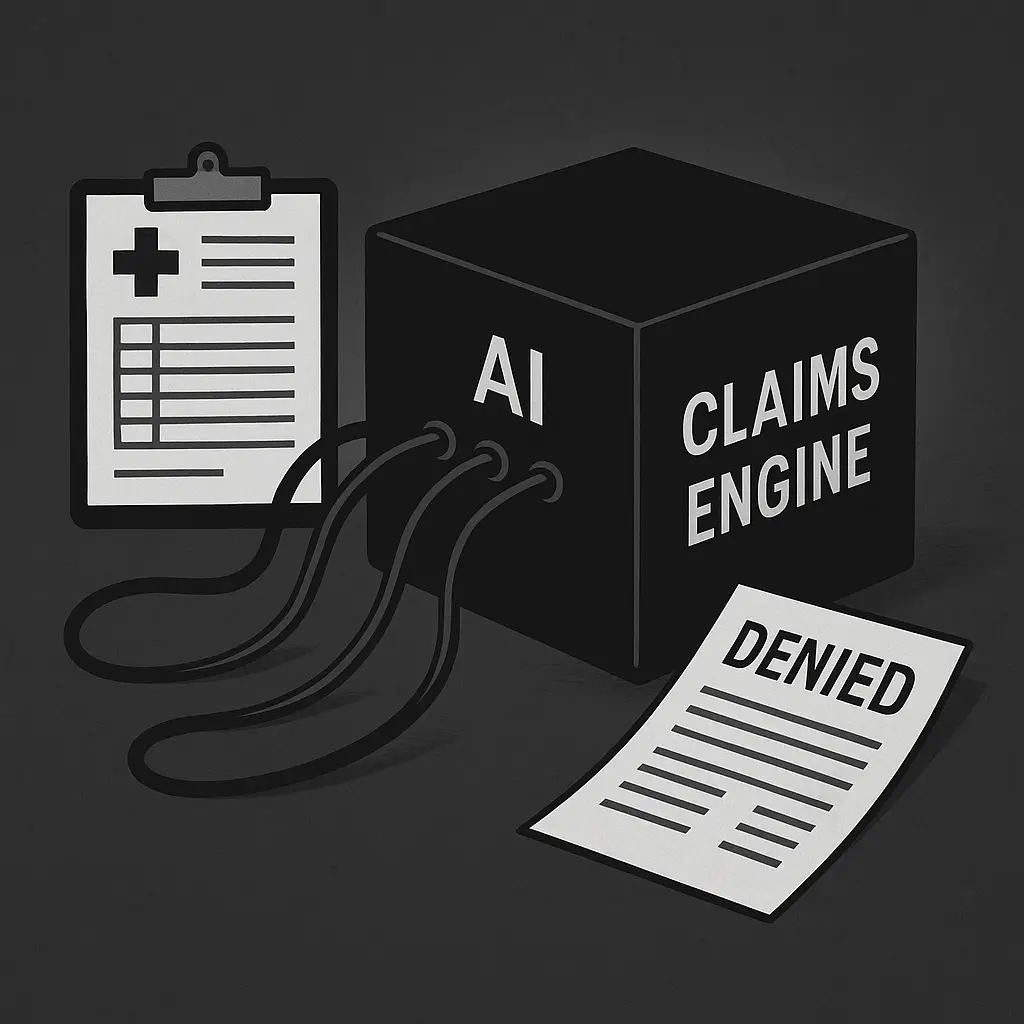
The 0.003 Second Denial
In late 2023, AARP reported on a jaw-dropping case involving UnitedHealthcare (UHC). UHC denied a retired man coverage for his recommended treatment. The kicker? AI medical claim denials. UHC used an AI model to review and deny claims in as little as 1.2 seconds. The appeals process took weeks. The patient never got the treatment. He died before anyone reprocessed the claim.
This isn’t science fiction. It’s healthcare in 2025.
We’re entering an era where algorithms make life-altering medical decisions faster than you can blink, often without human review. In theory, AI brings speed and efficiency. In practice, it can feel like the denial came from a black box that no one, not even the insurance company, can explain.
How AI Is Used in Claims Management
Healthcare has long embraced automation, but AI adoption is now accelerating. Today, many insurance companies use:
- Rules-based engines to flag non-compliant claims
- Predictive models to identify high-cost claims or “wasteful” treatments
- Natural language processing (NLP) to scan notes and match claims to guidelines
- Automated decisioning systems to approve or deny claims instantly
Companies like CognitiveScale, Optum, and Change Healthcare all offer AI-powered platforms to accelerate claims workflows. Payers argue this improves consistency, cuts costs, and speeds up resolutions.
But automation without transparency can create a dangerous vacuum.
Fast Denials, Slow Appeals
The core problem? AI-driven denials can be nearly instantaneous, but the appeals process remains glacial.
- A 2022 STAT News investigation highlighted Cigna’s use of an algorithm to auto-deny thousands of claims in under two seconds. Doctors later admitted they rarely reviewed the actual patient records.
- The Center for Medicare Advocacy found that Medicare Advantage plans routinely use automation to delay or deny medically necessary care.
While payers benefit from automation, patients and providers are left to fight through red tape. Insurers often send denial letters that lack clarity. Patients must invest time, documentation, and persistence to appeal.
Real-World Fallout
Patient Case Study: Ernestine Vargas (Public Case) Ernestine Vargas, a 91-year-old woman from California. Her Medicare Advantage plan denied coverage for a transfer to a skilled nursing facility. The plan’s AI system determined her stay was unnecessary, despite medical notes supporting it. Her daughter filed a lawsuit, arguing the denial directly contributed to her mother’s deteriorating condition and eventual death. [Source: Center for Medicare Advocacy, 2023]
Legal Case: UnitedHealthcare Class Action (2023) A proposed class action filed in California federal court accused UnitedHealthcare of using an AI algorithm that “rubber-stamped” denials of rehab and post-acute care. The model allegedly had a 90% denial rate. [Source: Becker’s Payer Issues | November 2023]
These aren’t isolated incidents. They reflect a systemic trend of AI medical claim denials where machines are used to cut costs, even when patient lives are at stake.
The Black Box Problem
Insurers rely on proprietary AI systems. That means:
- Patients can’t challenge the algorithm itself
- Insurers don’t inform doctors of the full criteria
- Regulators struggle to audit outcomes due to lack of visibility
This opacity raises the question: Can a patient appeal a decision if no one understands how it was made?
Even internal employees often don’t understand how the models weigh clinical, demographic, and financial data. The AI becomes a gatekeeper without oversight.
The Industry Response
Insurers argue that:
- AI helps reduce fraud, waste, and abuse
- Clinicians review the algorithms
- Insurers involve human reviewers in complex cases
But real-world investigations paint a different picture. In many cases, human review is nominal at best. Managers expect front-line workers to sign off on hundreds of claims a day, relying on pre-filled decisions.
The irony? Insurers promised automation would reduce clinician burnout, but it may just be shifting the burden to patients and caregivers.
What Needs to Change
If AI medical claim denials are here to stay in insurance, we need serious guardrails.
Recommended reforms:
- Transparency mandates: Disclose when AI is used and on what basis
- Audit trails: Require detailed documentation of decision logic
- Appeals modernization: Fast-track appeals for automated denials
- Federal oversight: Enforce ethical standards and test for bias
States like California and New York are exploring legislation requiring insurers to disclose algorithmic usage in coverage decisions. But most of the country still has no such requirements.
Final Thought: When the Algorithm Says No
We all want healthcare that’s faster, smarter, and more efficient. But if we let AI make life-or-death decisions without transparency or accountability, we risk losing the very thing healthcare is supposed to provide: care.
So the next time you get a denial letter, ask yourself:
Did a human say no — or did a machine?
Join the Conversation
Have you or someone you know been denied coverage by an insurance algorithm? Were you able to appeal it? Let us know in the comments or tag @infomedixsolutions on social media.
References
HealthCare Dive Staff. (2023, July 24). Cigna sued over algorithm allegedly used to deny claims. Healthcare Dive. https://www.healthcaredive.com/news/cigna-lawsuit-algorithm-claims-denials-california/688857/Healthcare Dive+1Healthcare Dive+1
Napolitano, E. (2023, November 20). UnitedHealth uses faulty AI to deny elderly patients medically necessary coverage, lawsuit claims. CBS News. https://www.cbsnews.com/news/unitedhealth-lawsuit-ai-deny-claims-medicare-advantage-health-insurance-denials/STAT+10CBS News+10Becker’s Payer Issues | Payer News+10
Reuters Staff. (2023, November 14). Lawsuit claims UnitedHealth AI wrongfully denies elderly extended care. Reuters. https://www.reuters.com/legal/lawsuit-claims-unitedhealth-ai-wrongfully-denies-elderly-extended-care-2023-11-14/STAT+2Reuters+2
Ross, C., & Herman, B. (2023, November 14). UnitedHealth faces class action lawsuit over algorithmic care denials in Medicare Advantage plans. STAT News. https://www.statnews.com/2023/11/14/unitedhealth-class-action-lawsuit-algorithm-medicare-advantage/Skilled Nursing News+2STAT+2STAT+2
Rucker, P., Armstrong, D., & Miller, M. (2023, March 25). How Cigna Saves Millions by Having Its Doctors Reject Claims Without Reading Them. ProPublica. https://www.propublica.org/article/cigna-pxdx-medical-health-insurance-rejection-claimsCBS News+2ProPublica+2Wikipedia+2
Wilson, R. (2023, November 15). UnitedHealth faces lawsuit over AI, Medicare Advantage care denials. Becker’s Payer Issues. https://www.beckerspayer.com/payer/unitedhealth-faces-lawsuit-over-medicare-advantage-care-denials/Becker’s Payer Issues | Payer News+3Becker’s Payer Issues | Payer News+3Skilled Nursing News+3