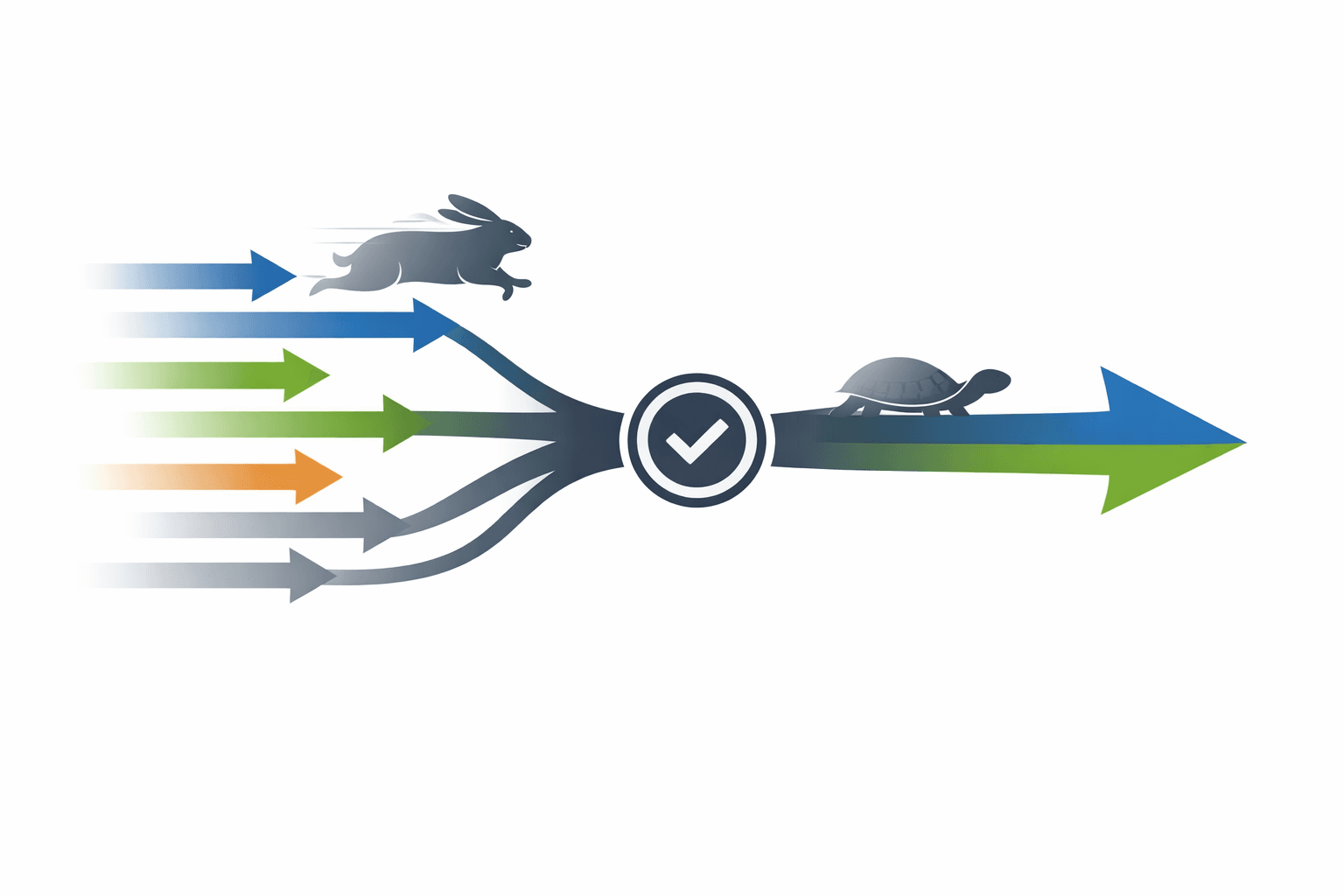
It’s designed that way.
A decision that felt obvious still took weeks to finalize.
We needed a way to work with data coming out of a new data warehouse. There were multiple options, but one solution clearly stood out based on usability and experience. From a technical perspective, the direction seemed straightforward.
But the decision didn’t move forward.
Instead, it expanded.
What began as a focused evaluation turned into a series of cross-functional reviews, product demonstrations, and stakeholder discussions. More people were brought into the process. More perspectives were considered. Each step added clarity, but it also added time.
Eventually, the decision landed where it was expected to from the beginning.
The delay wasn’t caused by uncertainty.
It was caused by how the organization was structured to make decisions. This pattern isn’t unique to one decision or one organization. It shows up anywhere hierarchy is used to make important calls.
The Assumption About Organizational Hierarchy
Most organizations assume that hierarchy helps decisions move efficiently.
If the right people are involved and the right process is followed, the thinking goes, decisions should become clearer and easier to make.
On the surface, this makes sense.
More perspectives should lead to better outcomes. Structured review should reduce risk. Leadership alignment should prevent mistakes.
But in practice, something different happens.
What Organizational Hierarchy Actually Solves
Hierarchy exists to answer a different set of questions.
Not “what is the fastest way to make this decision,” but:
• Who has the authority to approve it
• Who is accountable for the outcome
• Who is responsible if it fails
These questions matter, especially in complex organizations where decisions can have broad impact.
In the example above, the decision wasn’t just about selecting a tool. It affected reporting, operations, and financial visibility across the business. That made it an organizational decision, not just a technical one.
Before the decision could be finalized, the organization needed to answer a more fundamental question:
Who owns it?
Why Organizational Hierarchy Slows Decision-Making
Once ownership becomes the priority, speed becomes secondary.
The process changes.
More stakeholders are included. More perspectives are considered. The decision moves through layers of review, not because the answer is unclear, but because accountability needs to be shared or assigned.
Each additional layer adds coordination overhead.
Schedules have to align. Priorities shift. Meetings get delayed. New questions emerge as different parts of the organization evaluate the decision through their own lens.
From a distance, this can look inefficient.
In reality, the system is doing exactly what it was designed to do.
It is slowing the decision down long enough for the organization to agree on who is responsible for it.
The Tradeoff Between Speed and Accountability
It’s tempting to view these delays as process failures.
But they are often a reflection of something deeper.
Hierarchy is optimized for accountability, not speed.
When decisions carry risk, the system naturally expands to include the people who will ultimately be responsible for the outcome.
That expansion comes at a cost.
Decisions take longer. Momentum slows. Frustration builds for those trying to move quickly. But the tradeoff is intentional.
Hierarchy coordinates responsibility.
Informal networks coordinate speed.
In the case of that original decision, the outcome didn’t change. The same direction was chosen in the end. What changed was the process required for the organization to align around it.
The decision didn’t slow down because the answer was unclear.
It slowed down because the organization needed to agree on who owned it.