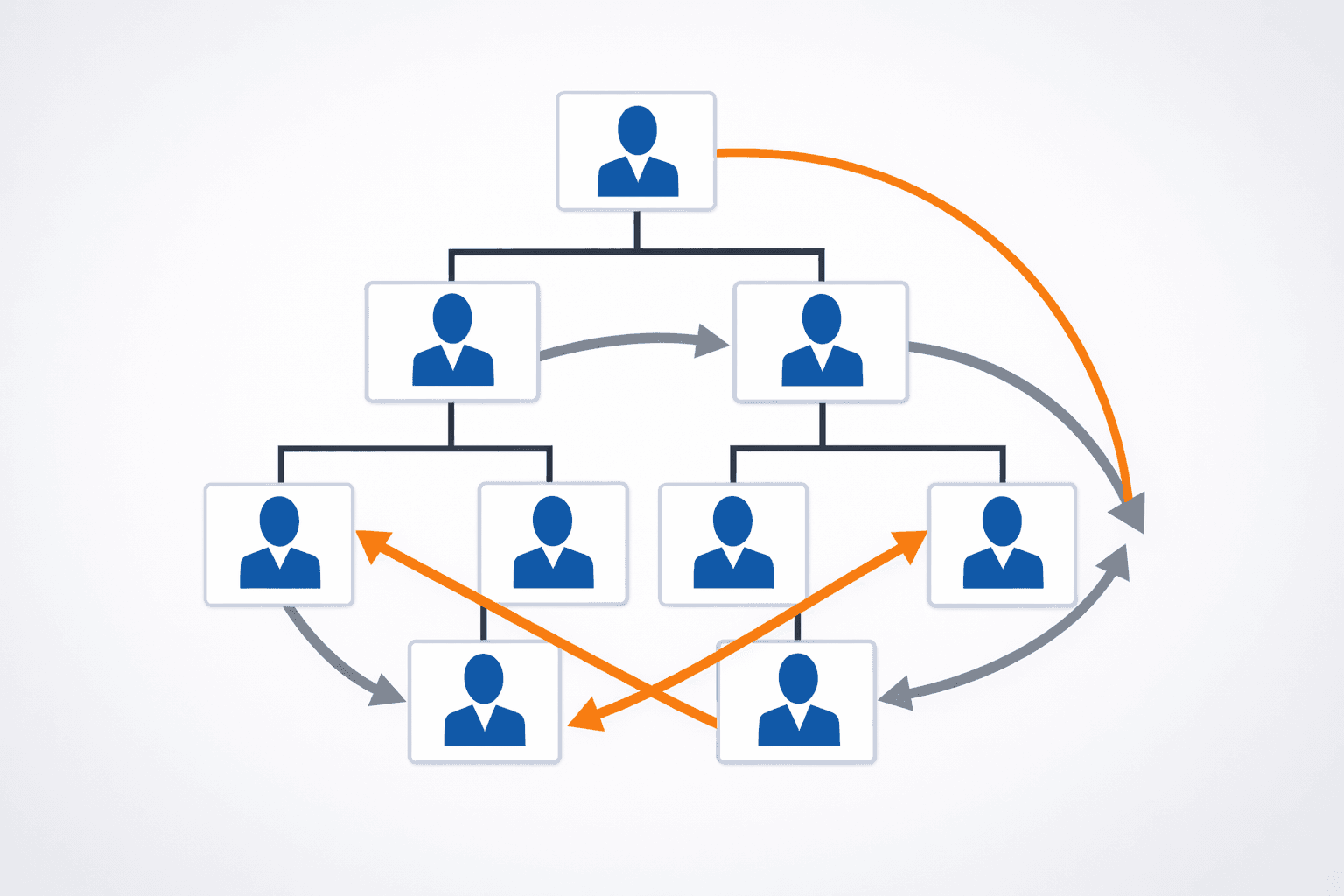
Informal communication networks often move work faster than formal reporting structures. That creates hidden coordination problems most organizations never notice.
I’ve seen this happen often enough that it no longer surprises me.
Someone needs a report quickly, so instead of going through the normal reporting structure, they go directly to the analyst they know will respond fastest. The analyst pauses whatever project work is already in progress and starts working on the new request. By the time leadership realizes what happened, the work is already halfway finished.
That might solve the immediate problem for the person asking. But it creates a different problem for everyone else.
Project timelines slip. Priorities change without visibility. Managers lose the ability to coordinate work because the real decisions about what gets done next are being made through side conversations instead of through the formal chain of command.
The Reality of Workplace Communication
This pattern shows up in almost every organization.
Most companies assume communication will follow the reporting hierarchy. If someone needs information, they ask their manager. If the manager doesn’t have the answer, the question moves up the chain until it reaches someone who does.
On paper, the structure makes sense.
In practice, it almost never works that way.
Instead, employees build informal communication networks. They message whoever can help them the fastest, regardless of titles or reporting lines. These side channels quietly become the real operating system of the organization.
At first glance, this behavior can look like a breakdown in discipline. If employees simply followed the chain of command, the problem would disappear.
Why Organizational Hierarchy Exists
But that explanation misses something important.
Most organizational hierarchies were not designed to move information quickly. They were designed to define authority and accountability.
A reporting structure answers questions like:
• Who has the authority to make a decision
• Who is responsible when something goes wrong
• Who evaluates performance
These are essential functions for any organization. But they are very different from solving day-to-day operational problems.
When someone needs an answer quickly, they aren’t thinking about accountability structures. They are thinking about speed. If they know a particular person can produce a report, answer a question, or fix a problem immediately, they will go directly to that person.
From their perspective, this makes perfect sense.
What Happens When Employees Bypass the Chain of Command
The problem is that while this behavior solves the requester’s immediate need, it quietly breaks the coordination mechanisms that managers rely on. Work gets reprioritized without visibility. Projects slow down for reasons that are difficult to trace. Leaders believe a team is working on one set of priorities while the actual work happening on the ground is something else entirely.
In small doses, this isn’t necessarily harmful. Informal access can make teams feel responsive and collaborative. A quick request here or there rarely disrupts an organization.
The problem appears when this becomes the default way work gets done.
When employees learn that direct access produces faster results, they naturally begin using that path more often. Over time, analysts and technical specialists become magnets for urgent requests. Instead of working through planned priorities, they spend much of their time responding to whatever problem appears in front of them.
From the requester’s perspective, this feels efficient. Their problem gets solved quickly.
The Needs of the Many…
From the team’s perspective, something very different is happening.
Project work slows down because priorities are constantly interrupted. Managers lose visibility into what their teams are actually working on. Deadlines slip for reasons that are difficult to trace because the reprioritization never passed through the normal coordination process.
Eventually, the formal reporting structure stops reflecting reality. The organization still has a hierarchy on paper, but the flow of work is determined by informal conversations, hallway requests, and whoever happens to have the most immediate need.
When that happens, the organization hasn’t eliminated hierarchy.
It has simply replaced it with something far less visible.
The instinctive reaction to this pattern is often to enforce the chain of command more strictly. Managers remind employees to route requests through the proper channels. Teams introduce intake forms, ticketing systems, or reporting protocols designed to control how work enters the pipeline.
Sometimes those tools help. Often they don’t.
The Hidden Cost of Informal Workflows
The reason is simple: informal access exists because people are trying to solve problems quickly. As long as the fastest path to a solution runs through direct access to a particular person, employees will continue using that path regardless of the official structure.
This doesn’t mean the chain of command is unnecessary. Organizational hierarchy still plays an important role in setting priorities, coordinating work, and assigning accountability.
But leaders should recognize that the org chart rarely reflects how work actually flows.
The real organization is often defined by informal networks, trusted problem-solvers, and the people who know how to get things done quickly. Ignoring those networks doesn’t make them disappear. It simply means the organization is being managed based on a structure that only exists on paper.
The chain of command describes how authority is structured.
Informal networks reveal how work actually gets done.
Have you seen this happen in your organization?
I’d be interested to hear how other teams deal with it.