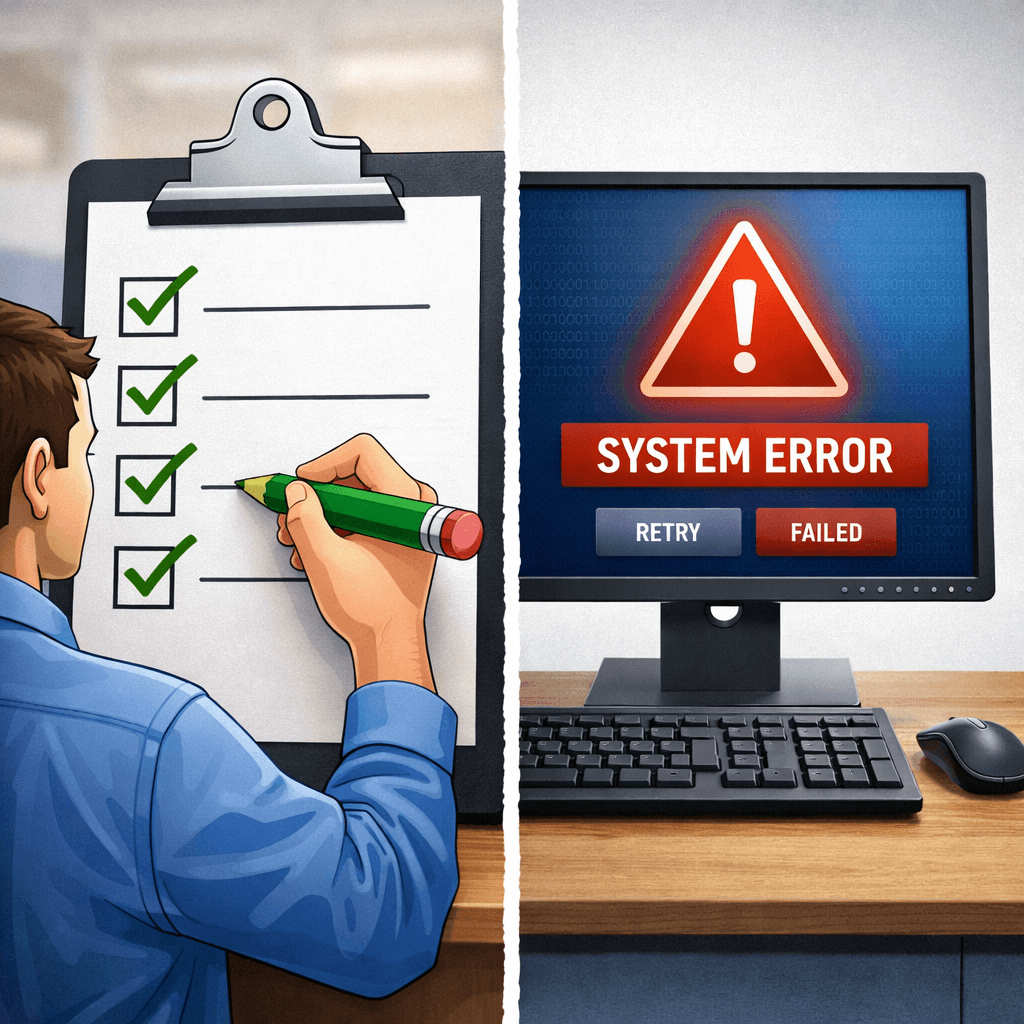
Work was marked done, but not tested.
But no one could actually use it.
The system set up is finished.
The installation was complete.
From a checklist perspective, everything looked finished.
But when someone tried to use it, it didn’t work.
Access was not configured.
Users weren’t set up.
The final step, the one that actually made it usable, hadn’t been done.
Technically, the work was complete.
In reality, it wasn’t.
Completion is declared. Verification is assumed. And that assumption is where most failures begin.
This isn’t an isolated case. It shows up in small ways across everyday work.
Why This Happens
Organizations reward completion of tasks, not validation of outcomes.
There is constant pressure in most workplaces to show progress. When something is marked complete, it signals movement, productivity, and value. That pressure alone can drive premature closure.
But completion raises a different question:
Did it actually work?
From an individual perspective, marking something “done” provides cognitive relief. It reduces mental load. A task disappears from the list, and with it comes a sense of closure.
That feeling creates a natural pull toward finishing things and moving on.
Workload makes this worse.
When people are overloaded, finishing something feels like progress, even if it hasn’t been fully verified. Validation becomes an extra step, and under pressure, extra steps are often skipped.
In many cases, it doesn’t even feel like a conscious decision. Verification simply never happens.
Ownership adds another layer.
Who is responsible for verifying that something actually works?
In many environments, especially in technical work, systems are built for someone else. The assumption becomes that the end user will validate the outcome. But if that expectation isn’t clearly defined, it creates a gap.
The builder thinks their part is done.
The user assumes it was already tested.
No one actually verifies it.
There is also a social component.
Saying something is “done” signals progress and reliability. It shows that work is moving forward.
Saying “this needs further testing” can feel like hesitation. It can be interpreted as uncertainty or delay.
So people lean toward completion.
Over time, this creates a pattern:
Completion is rewarded.
Verification becomes optional.
Work is considered complete when the steps are finished, not when the outcome is proven.
What Happens When “Done” Isn’t Proven
When work is marked done but not tested, the outcome becomes unpredictable.
Sometimes it works.
Sometimes it doesn’t.
That uncertainty is the first problem.
The second problem is timing.
Failures rarely show up immediately. They appear later, when the process is actually used. By that point, the context is gone. The work has already been handed off. What should have been a simple validation step turns into a reactive investigation.
Now time is spent:
• identifying the issue
• tracing the root cause
• fixing the problem
• retesting the solution
All of that work could have been avoided with proper verification upfront.
The third problem is trust.
When something is delivered as complete but doesn’t work, confidence takes a hit. Not just in the work itself, but in the person or team delivering it.
Over time, this creates a pattern:
• more rework
• more second-guessing
• more oversight
Eventually, even good work gets questioned because reliability is no longer assumed.
In some environments, the impact goes further.
For example, in operational settings, broken processes can disrupt workflows. With regulated industries, incomplete validation can introduce compliance risk. Then in healthcare, failures can affect continuity of care or expose sensitive data.
What looks like a small shortcut at the end of a task can have outsized consequences once the work is put into use. The cost of skipping verification isn’t speed. It’s delayed failure.
Done vs Proven
The problem isn’t that people don’t care about quality.
It’s that “done” is often defined incorrectly.
In most workflows, work is considered complete when the steps are finished. The task is checked off, the deliverable is handed over, and the responsibility moves on.
But completion of steps is not the same as validation of outcomes.
Something can be built, configured, or delivered exactly as intended and still fail when it is actually used.
That gap is where most problems occur.
The difference comes down to one concept:
Was worked marked done, but not tested? Was it proven?
“Done” means the work has been completed.
“Proven” means the outcome has been tested, validated, and confirmed to work in the real environment it was built for.
Without that second step, completion is based on assumption.
And assumptions are where systems break.
A Simple Way to Close the Loop
Before marking something complete, ask a few simple questions:
• Did you verify the desired outcome or just the steps completed
• Who has actually confirmed that it works
• If something were wrong, where would this fail first
• What assumption are you making that hasn’t been tested
These questions take very little time.
But they force a shift from:
completion
to
confirmation
Completion declares the work is finished.
Verification proves it actually works.